Ready for your VDR annual performance test — before the technician steps aboard.
A VDR annual performance test (APT) is the yearly SOLAS-mandated check that confirms your Voyage Data Recorder is capturing, storing and retrieving data correctly. Most vessels only find out something is wrong when the technician arrives — Navguide Solutions builds that readiness in advance, with a pre-APT checklist inside Guide2Inspections and a team of empanelled analysts who carry out VDR and Remote Navigation Audits year-round.
What is a VDR annual performance test?
Under SOLAS Chapter V, Regulation 20, every passenger ship and every ship of 3,000 GRT and above fitted with a Voyage Data Recorder must have that VDR tested annually by an approved testing or servicing facility. The test — commonly called the VDR APT — confirms the unit is correctly capturing the data it's legally required to capture: bridge audio, VHF communications, radar images, AIS, GPS position, speed, heading, and the other data channels defined by the performance standard. A pass keeps the vessel compliant and keeps that data usable if it's ever needed for an accident or incident investigation. A fail — discovered on the day, with the technician standing on the bridge — usually means downtime, a follow-up visit, and a compliance gap the vessel was carrying without knowing it.
The same requirement applies, in a lighter form, to the Simplified VDR (S-VDR)carried on older cargo ships: fewer mandatory data channels, but the same annual testing obligation and the same risk if the unit isn't ready when the tester arrives.
Why "VDR audit" readiness gets treated as an afterthought
What the SERP shows you
Search for "VDR audit" and you'll mostly find something else entirely — Virtual Data Room software for financial due diligence, a completely different industry using the same three letters. Search more precisely for the VDR annual performance test itself, and the results are dominated by hardware manufacturers and physical testing facilities: companies that will send a technician to test the box, and regulation text explaining why they have to. What's missing from that list is anyone treating the APT as a readiness problem rather than a booking problem.
What Navguide Solutions does
That's the gap. Nobody prepares the vessel for the technician's visit the way they'd prepare for a SIRE 2.0 or Port State Control inspection — checking the data before the data is checked for them. Navguide Solutions treats VDR readiness as part of the same always-inspection-ready discipline we build for every other regime: know the gap before the auditor, technician or inspector finds it for you.
The pre-APT readiness checklist inside Guide2Inspections
Guide2Inspections includes a pre-APT readiness checklist your bridge team can work through before the testing facility's technician comes aboard — the same zone-based, video-and-checklist approach used across the app's other inspection modules, applied to the VDR.
Data integrity checks
Confirm the VDR is continuously recording the required data channels — bridge audio, VHF, radar, AIS, GPS, speed and heading log, among others — without gaps, corruption or channels silently dropping out between voyages.
Sensor and equipment verification
Walk the interfaced sensors and confirm each is feeding the VDR correctly: the checklist flags the equipment types that most often cause an APT to fail on the day — a disconnected or degraded sensor input is one of the most common findings a technician reports.
Retrievability tests
Confirm the fixed and float-free capsules can actually be retrieved and the stored data can actually be played back — the part of the system nobody checks until the day it's needed for a real investigation.
Documentation the surveyor will ask for
The checklist also flags the paperwork side: last APT certificate, service history, any open non-conformities from the previous test, and the manufacturer's maintenance records the technician will expect to see before starting.
None of this replaces the technician's own test — it means your crew walks into that test already knowing where the vessel stands, instead of finding out live.
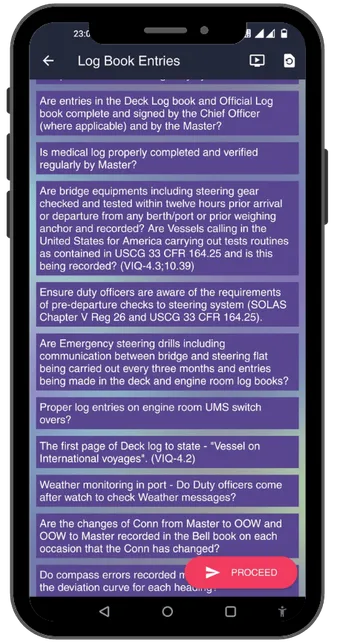
Don't find out on the day the technician arrives.
See the pre-APT readiness checklist working inside Guide2Inspections.
What can go wrong — and what it costs
Most VDR non-conformities aren't dramatic system failures. They're the small, unglamorous things a readiness check is built to catch: a sensor feed that degraded months ago and nobody noticed because the VDR kept "recording" regardless of whether the input was good; a capsule that's never actually been retrieved and played back since installation; a data channel that silently stopped populating after a software update; a service history with an open non-conformity from last year's test that was never closed out. None of these show up until someone looks — either the technician on the day, or your own crew beforehand.
The reason readiness is worth building deliberately, rather than leaving to the day of the test, is the same reason it matters for every other inspection regime a vessel faces: a finding discovered in advance is a fix; a finding discovered by an outside party during a live audit or inspection is a deficiency on the record — and, in the more serious inspection contexts this audit work sits alongside,
a detention can mean loss of hire that can exceed US$100,000 a day.
A VDR APT failure alone rarely reaches that scale, but it's part of the same pattern Navguide Solutions exists to break: problems that were always fixable, discovered too late to fix quietly.
VDR & S-VDR — what's different, what's the same
Both the full VDR and the Simplified VDR (S-VDR) fitted to older cargo vessels are subject to the same annual performance testing obligation under SOLAS. The practical differences are in what each unit is required to capture — the S-VDR standard covers fewer mandatory channels than a full VDR — but the readiness discipline is identical: verify the data, verify the sensors, verify retrievability, verify the paperwork, before the test date arrives.
| Full VDR | S-VDR | |
|---|---|---|
| Applies to | Passenger ships; cargo ships ≥ 3,000 GRT (per SOLAS Ch. V Reg. 20 thresholds) | Older cargo ships meeting the simplified-fit criteria |
| Data channels required | Full channel set (bridge audio, VHF, radar, AIS, GPS, speed/heading, and others per the performance standard) | A reduced mandatory channel set |
| Annual performance test | Required | Required |
| Readiness discipline | Data integrity · sensors · retrievability · documentation | Same four checks, scoped to the fitted channel set |
Table content is a general regulatory-structure summary for orientation, not a substitute for the vessel's own class/flag-specific fit documentation.
Our Vessel Inspection & Remote Navigation Audit services
VDR readiness is one part of a broader vessel inspection and remote navigation audit practice Navguide Solutions runs through an experienced team of empanelled analysts and auditors — the same people, in many cases, who wrote the readiness checklists above.
Types of audits we run
| Audit type | Duration | Notes |
|---|---|---|
| Flash Audit | Up to 4 hours | VDR data and related documentation, covering any one critical operation (report excludes equipment status). |
| VDR Analysis | 6 hours | — |
| VDR & Remote Navigation Audit | 12 hours | — |
| VDR & Remote Navigation Audit | 36 hours | — |
| Accident & Incident Investigations | — | — |
Accident and incident investigations.
What our analysts evaluate
Our team listens to the VDR data and evaluates bridge equipment performance and use — radar, ECDIS, echo sounder and other relevant navigation equipment — plus the bridge team's working practices against best practice, including:
- Under-keel clearance (UKC) requirements
- Navigation with pilot aboard
- Collision avoidance
- Near-miss identification
- Gap analysis against the passage plan
- Human factors
- Additional training needs
Who this is for
- Shipping companies staying compliant with SOLAS, VIQ, TMSA and DBMS requirements, or running internal training and quality reviews
- P&I clubs
- Flag State authorities
- National accident investigators
- Enforcement authorities
- Marine consultancies
Vetting and PSC teams already reading our SIRE 2.0 readiness and RightShip / RISQ preparation guidance are a natural fit for this page too.
Meet a few of our empanelled auditors
Capt. Indraneel Chari
Ex-Master Mariner, maritime trainer and auditor since 2007
Capt. Robert Shane Vaz
Chief Operating Officer, Navguide Solutions — Ex-Master Mariner, maritime auditor and trainer since 2011
Capt. Saurabh Saraswat
Ex-Master Mariner, maritime auditor, Founder Partner of Beaufort Marine LLP
Capt. Arnab Bhattacharya
Ex-Master Mariner, maritime auditor
View the full empanelled list
Navguide Solutions' empanelled panel runs to 14+ trainers and auditors, including Capt. Tapan Kr. Banerjee, Capt. Pankaj Kumar, Capt. Anurag Wadhwa, Capt. Razvan Moise and other empanelled auditors and trainers.
How compliant reporting works
Our reports are built to be compliant with the standards that actually govern this work:
- SOLAS Chapter V, Regulation 20 — the base requirement: all passenger ships and other ships of 3,000 GRT and above must carry a VDR to assist accident investigation.
- TMSA 5.4.2 (Tankers)
- OCIMF VIQ 4.10.48 (Tankers)
- DBMS (Bulk Carriers)
We're also ABS Certified for carrying out marine inspections and audits, and we train VDR analysts ourselves, not only deploy them — the same multiple-check-point discipline that runs through Guide2Inspections runs through the audit team's own methodology, so a report from Navguide Solutions reads the same way whether the underlying work is a 4-hour Flash Audit or a full accident investigation.
We're not just providing an inspection service — we pair an experienced, empanelled list of individual auditors and analysts with the same digital tooling that powers Guide2Inspections. That combination — real inspectors, backed by a readiness platform — is what sets the audit practice apart from a testing facility that only shows up once a year.
The same multiple-check-point discipline underlies our Port State Control preparation guidance.
How to request an audit
- Request an audit. Use the button below to tell us your primary need — a single VDR APT readiness check, a full Remote Navigation Audit, or an accident/incident investigation — or to ask about the different audit formats above. Or reach us directly via our contact page.
- Discuss the details. We confirm scope, vessel type, and timing with you.
- Info we need. We'll ask for the vessel particulars and access needed to pull VDR data.
- Data validation. Our analysts review and validate what's been retrieved.
- Report back. You receive a structured, audit-ready report against the compliance standards relevant to your vessel type.
Straight answers.
What is tested during a VDR annual performance test?
The test confirms the VDR is correctly capturing, storing and can retrieve its required data channels — bridge audio, VHF communications, radar images, AIS, GPS position, speed and heading — and that the fixed and float-free recording capsules can be recovered and played back.
How often must a VDR be tested under SOLAS?
Annually. SOLAS Chapter V, Regulation 20 requires an annual performance test by an approved testing or servicing facility for every VDR-fitted vessel it covers.
What happens if a VDR fails its annual performance test?
The vessel typically needs a follow-up visit and repair before the unit is certified compliant, which can mean downtime and a compliance gap between the failed test and the fix — the exact scenario a pre-APT readiness check is designed to catch in advance.
What's the difference between VDR and S-VDR testing requirements?
Both are subject to the same annual testing obligation; the S-VDR standard fitted to older cargo vessels covers fewer mandatory data channels than a full VDR, but the same readiness discipline — verify data, sensors, retrievability, documentation — applies to both.
Who is authorized to conduct a VDR annual performance test?
An approved testing or servicing facility recognized for VDR APT work carries out the test itself; Navguide Solutions' role is readiness — the checklist and audit work that gets a vessel prepared for that visit, plus the broader Remote Navigation Audit services above.
Do you only work with tankers?
No. Our audit and inspection work spans tankers, bulk carriers and other vessel types — the compliance standards referenced above (TMSA/VIQ for tankers, DBMS for bulk carriers) reflect that range.
Don't wait for the technician's visit to find out you weren't ready.
A 30-minute walkthrough of VDR readiness inside Guide2Inspections, and our audit services beyond it.
Prefer email? Get in touch directly.