The maritime LMS built to fix what SIRE 2.0 keeps finding: human error.
Navguide Solutions' maritime LMS is a rank-based, offline-and-online training platform built around short, filmed, scenario-driven microlearning rather than long-form courses. It holds 430+ learning modules — 90+ videos and 195+ simulation games, alongside quizzes and other units — assembled into 230+ structured courses, built specifically to close the human-factor gap behind a large share of SIRE 2.0 negative observations.
What is a maritime LMS, and how is this one different?
A Learning Management System for the maritime industry is, at minimum, a way to assign, deliver and track training for seafarers — certificates completed, courses assigned, compliance recorded. Most maritime LMS platforms on the market today fall into one of two camps: generic corporate LMS software with a maritime label bolted on, or course-catalog training academies selling long, seat-based modules built around STCW-style classroom content.
Navguide Solutions built something between those two camps, on purpose. The platform — known internally as the Maritime Skill Enhancer — is maritime-native from the ground up: rank-based assignment, a Kirkpatrick-model evaluation approachto actually measure whether training changed behaviour rather than just completion rates, and a hybrid offline/online design built for crew who spend weeks at a time without reliable connectivity. It's also, deliberately, positioned against a specific, documented problem rather than a generic "upskilling" promise: 37% of SIRE 2.0 negative observations are human-factor-related. Training tied directly to that finding — not a generic compliance course — is the whole premise of the platform.
The white-labelled version of this same LMS runs at kaizenship.training, offered to shipping companies and training institutes that want the platform under their own name. Underneath the product decisions sits a genuine research investment, not a marketing claim: the content library is built on 48 months of researchinto what actually happens onboard and during an inspection — the same research discipline that shapes every other Navguide Solutions product, translated here into a library sized at 430+ modules across 230+ courses.
Inside the library — 430+ modules, 230+ courses
The library runs to 430+ modules — a module is a single learning unit: one video, one game, one quiz, or a similar self-contained piece — assembled into 230+ structured courses spanning Bridge, Engine Room, Deck, Cargo, Safety, Documentation and more. Of the 430+ modules, 90+ are filmed videosand 195+ are simulation games; the remainder are quizzes and other assessment units woven through the courses.
Filmed on real ships, narrated by masters, chief engineers and auditors.
Scenario-based, interactive modules — nearly half the library.
The connective tissue woven between videos and games inside each course.
90+ videos, filmed on real ships
The video library is built on a specific, deliberate production choice: everything is narrated by subject-matter experts — masters, chief engineers, auditors — never AI voiceovers, so the crew member watching subconsciously feels they're learning the job from someone who's actually done it. Videos are filmed in first-person, camera moving the way a person would move on the ship, on the real vessel rather than an animated recreation — a deliberately different choice from most maritime e-learning, which leans on generic stock footage or animation. Each video runs 3–5 minutes: short enough to watch between tasks, long enough to carry real field experience — collectively, Navguide's video library represents well over a hundred years of combined sea-time expertise distilled into that format.
Quizzes and knowledge checks
The remaining modules are quizzes and short knowledge checks woven between videos and games inside each course — not a separate bolt-on testing layer, but the connective tissue that turns a sequence of videos and games into a structured course a rank can be assessed against.
See the library working for your own fleet.
A walkthrough of the modules, the courses, and how rank-based assignment actually runs.
Simulation & Games
195+ simulation games
Nearly half the entire module library — 195+ of the 430+ modules — is simulation games, not passive video. This is the section that most separates Navguide's LMS from a course-catalog competitor: scenario-based, interactive modules where a seafarer makes decisions inside a simulated situation rather than watching a video about one.
Interview and scenario simulations
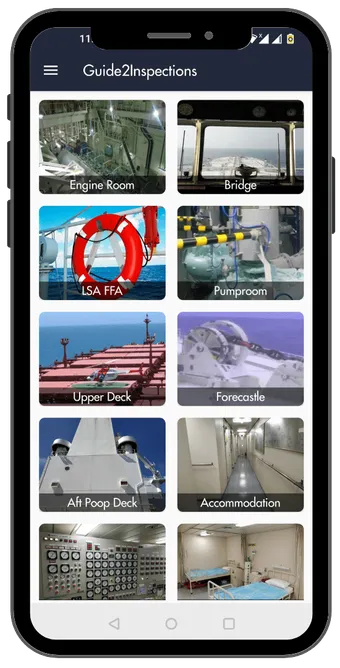
A specific category inside the simulation library is built around interview and personal-assessment scenarios — the kind of live questioning a crew member faces during a SIRE, RightShip or Port State personal interview. Rather than reading about what an inspector might ask, the seafarer works through a simulated interview scenario and gets feedback on the response, the same discipline the Guide2Inspections app applies to crew-interview readiness on the inspection side.
Gamified evaluations — assessment that doesn't feel like a test
Alongside the learning library sits a set of gamified evaluation modules, purpose-built for assessing crew skills — for promotion decisions, new-hire evaluation, or a periodic competency check. The design goal is explicit: replace the mundane evaluation form with something that feels less like a test and more like a structured, interactive assessment, because an engaged crew member gives you a more honest read of their actual competence than one filling in a form under pressure.
Dynamic, engaging assessment
Interactive rather than a static form, so the process itself doesn’t work against getting an honest result.
Precise, spot-on skill measurement
Designed so no part of a crew member’s ability goes unchecked, with the scale to cover a small team or an entire fleet, across ranks and skill levels.
Personalized feedback
Every crew member gets feedback tailored to their own performance, not a generic pass/fail, pointing at what to work on next.
How microlearning actually changes behaviour onboard
The reasoning behind this whole design isn't a preference for short-form video for its own sake. It's a direct response to how seafarers have historically been trained: through text-based instructions, trickle-down learning from a senior officer whenever time allowed, and classroom courses that don't scale to a global, rotating crew. Careers that once took roughly twenty years to reach Master now often take eight to ten — meaning far less time at sea for the kind of informal mentorship that used to fill the gap. The maritime industry, in Navguide's own framing, has "overfed the 10%" — the formal course — while starving the 70% and 20% of the classic 70:20:10 learning model: on-the-job practice and peer mentorship, the parts where real competence is actually built.
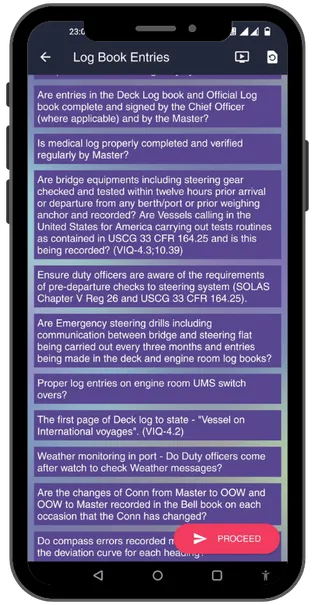
Guide2Inspections' training layer is built to close that specific gap: not by adding more courses, but by acting as a mentor in a crew member's pocket — short, visual, filmed-on-a-real-ship content that substitutes for the mentorship a compressed career no longer leaves enough time for. The underlying goal, in Navguide's own words, is results over courses: what a seafarer can actually do differently on watch, not how many hours of video they've technically completed.
Why microlearning specifically, and not longer-form e-learning? The case for short-form content isn't a production shortcut — it's a deliberate response to how attention and retention actually work for a workforce that's largely millennial and Gen-Z, the largest and least understood segment of today's maritime workforce, and one that doesn't respond well to rigid, authority-based, sit-through-the-whole-course training. A 3–5 minute video fits inside a break between watches; a 45-minute lecture-style module doesn't. Gamification compounds the same effect: a scenario the seafarer actively works through is remembered differently than a slide deck they clicked through. This is also, notably, the one part of Navguide's content that already ranks organically — an existing blog post on microlearning and gamification as "a winning formula for safer ships" holds a page-one position for the microlearning query today, and its core argument folds directly into this section rather than being retired: structure, not content volume, is what makes training stick. "Not the content. The structure!"
Built for rank, built for offline life at sea
Training is assigned by rank, so an Officer of the Watch and a Chief Engineer aren't handed the same generic content — each rank's courses draw from the modules relevant to that role's actual work. The platform runs as a hybrid: usable online for shore staff and connected vessels, and built to keep working offline onboard for the long stretches at sea where connectivity isn't reliable, the same offline-first discipline that runs through the wider Guide2Inspections product line.
Evaluation follows the same rank-aware logic. Rather than a single blanket "completed / not completed" flag, the platform is built around a Kirkpatrick-style evaluation model — checking not just whether a module was watched, but whether it changed what the seafarer knows, how they'd respond in a scenario, and ultimately what they do differently on the job. That's the same principle behind the gamified evaluation modules above: measuring skill, not attendance.
Who uses it
Shipping companies training their own fleets
HSEQ, Training and Vetting departments assign the LMS directly to their crews — rank-based courses, video-and-game modules tied to the inspection regimes their fleet actually faces (SIRE 2.0, RightShip, Port State Control), and gamified evaluations for promotion and new-hire decisions.
Training institutes — the white-labelled LMS
The same platform is offered white-labelled, under kaizenship.training, to training institutes and shipping companies that want the full 230+ course library and simulation-game content under their own brand rather than building a library from scratch. For an institute, that means a maritime-native course catalogue — Bridge, Engine Room, Deck, Cargo, Safety, Documentation and more — with the Kirkpatrick-model evaluation layer already built in, rather than commissioning original video and simulation content from the ground up or retrofitting a generic corporate LMS to maritime subject matter. Get in touch via our contact page to discuss a white-label rollout for your institute or fleet.
Training your fleet, or white-labelling for your institute?
Either way, the same 430+ module library and evaluation layer — see it under kaizenship.training or your own brand.
Prefer to skip the call? Send us the details directly.
How training ties back to inspection readiness
This LMS doesn't exist in isolation from the rest of Navguide Solutions' work. The same 37% human-factor finding that drives the Guide2Inspections app's crew-interview-readiness features drives the LMS's course content — the two products are built from the same underlying research into what actually goes wrong during an inspection, and are meant to be used together: the app for zone-by-zone, in-the-moment inspection readiness, the LMS for the underlying skill and scenario training that makes those observations less likely to happen in the first place. Fleets already using Guide2Inspections for inspection readiness are a natural fit for the LMS; fleets starting from the LMS get a direct path into the wider inspection-readiness suite.
The same training discipline extends to Navguide's own inspection and audit teams — we train VDR analysts ourselves rather than only deploying them; see our VDR audit services for how that plays out beyond the LMS.
Straight answers.
What is the best LMS for maritime training?
The right maritime LMS is one built around how seafarers actually learn at sea — rank-based, short-form, video- and scenario-driven, and usable offline — rather than a generic corporate LMS with maritime labels added on. Navguide Solutions’ platform (the Maritime Skill Enhancer) is built specifically for that: 430+ modules across 230+ courses, filmed on real ships and narrated by subject-matter experts.
Does maritime LMS training count toward STCW compliance?
Course content spans STCW-relevant subject areas (Bridge, Engine Room, Deck, Cargo, Safety, Documentation), but STCW certification requirements are set by flag administrations and approved training providers — confirm specific certificate-of-competency requirements with your flag state or class society rather than assuming any LMS course substitutes for a mandatory STCW certification course.
What is microlearning in maritime crew training?
Microlearning breaks training into short, focused units — in Navguide’s library, 3–5 minute filmed videos and short simulation games — rather than long-form classroom-style courses, on the premise that short, visual, scenario-based content is both easier to fit into a working watch schedule and more likely to be retained than a long lecture-style module.
Can seafarers complete LMS training offline onboard?
Yes — the platform is built as a hybrid online/offline system specifically because vessels spend long stretches without reliable connectivity; crew can work through assigned modules offline and progress syncs when connectivity is available.
How does maritime training reduce SIRE 2.0 human-factor findings?
By directly targeting the specific skill and scenario gaps behind the finding — 37% of SIRE 2.0 negative observations are human-factor-related — rather than generic compliance training. Scenario-based simulation games and interview-simulation modules give crew practice with the exact kind of situational judgment and interview readiness that inspectors are assessing, before they face it for real.
What’s the difference between the videos and the simulation games?
Videos (90+ in the library) are filmed, narrated instruction — a subject-matter expert showing and explaining a task or procedure on a real ship. Simulation games (195+) are interactive: the seafarer makes decisions inside a scenario and gets feedback on the outcome, including a dedicated set built around interview and personal-assessment situations.
Give your crew a mentor in their pocket, not another course to sit through.
A walkthrough of the library, the simulation games, and the evaluation layer — your ranks, your fleet.