What Is a SIRE Inspection? A Plain-English Guide to Vetting Readiness
A SIRE inspection is a tanker vetting inspection run under OCIMF's Ship Inspection Report (SIRE) Programme — the mechanism oil majors, charterers and terminal operators use to assess whether a tanker is safe and well-run enough to charter or berth. Since 2023, OCIMF has been rolling out SIRE 2.0, a risk-based evolution of the same programme with a dedicated human-element assessment. If your fleet is preparing for the new framework specifically, see our full guide: SIRE 2.0 Readiness.
Get your fleet vetting-ready before the next inspection window.
A 30-minute walkthrough with a master mariner — your trades, your inspection regimes, your questions.
Who Runs SIRE Inspections, and Why They Matter
SIRE inspections are commissioned by OCIMF programme recipients — oil majors, charterers, terminal operators — and carried out by OCIMF-accredited inspectors. A clean SIRE record isn't a regulatory formality; it directly affects whether a tanker gets fixed for the next charter, and recurring negative observations can quietly narrow which charterers will work with a vessel at all. That's why "vetting-ready" is a commercial readiness question as much as a safety one.
SIRE vs SIRE 2.0, in Brief
The short version: legacy SIRE (built on the VIQ7 questionnaire) uses a fixed question set applied the same way every time. SIRE 2.0 replaces it with the Core Vessel Inspection Questionnaire (CVIQ) — core, vessel-specific and rotational questions, plus a dedicated human-element assessment — and shifts the expectation from "get ready before the inspector arrives" to continuous readiness. Navguide Solutions' own analysis of 100,000+ inspection observations across 300+ vessel operators found that 37% of negative SIRE 2.0 observations are human-factor-related — not equipment failures. The full breakdown, comparison table and checklist live on our SIRE 2.0 Readiness guide.
0observations analysed
| SIRE 1.0 | SIRE 2.0 | |
|---|---|---|
| Question set | Fixed VIQ7 checklist | CVIQ — core, vessel-specific and rotational |
| Human element | Assessed indirectly | Dedicated human-element question set |
| Readiness model | Prepare before the inspection window | Continuous readiness, always charter-ready |
What a SIRE Inspector Actually Looks At
At a high level, a SIRE inspection covers three layers, in roughly this order of attention:
Documentation
SMS procedures, certificates, PIQ/HVPQ data, and whether what's on paper matches what actually happens on board.
Hardware and condition
Bridge and deck equipment, safety systems, general maintenance standard, verified against PMS records.
Crew conduct and understanding
Whether officers and crew can explain the "why" behind a procedure, not just perform it by rote; this is where SIRE 2.0's human-element questions concentrate.
Vessels that treat this as a project to run before a known inspection date consistently struggle with the third layer, because crew confidence isn't something you can cram for in a weekend. Vessels that run continuous self-inspection tend not to have that problem — which is the whole premise behind Guide2Inspections.
How Navguide Solutions Helps Vessels Stay Vetting-Ready
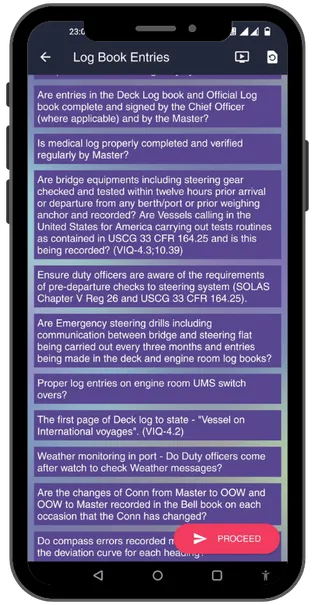
Guide2Inspections divides the ship into physical zones and puts short, master- and chief-engineer-narrated guidance videos and structured self-inspection checklists on the same phone your crew already carries — built from the same 100,000+ observation dataset referenced above. It covers SIRE 2.0, RightShip RISQ and Port State Control from one app, so a vessel preparing for one inspection regime is, in practice, preparing for all three. See the full product walkthrough on the Guide2Inspections app page, or go straight to the framework-specific detail on SIRE 2.0 Readiness.
See Guide2Inspections on your own fleet.
A 30-minute walkthrough with a master mariner — your trades, your inspection regimes, your questions.
Frequently Asked Questions
What is a SIRE inspection?
A SIRE inspection is a tanker vetting inspection conducted under OCIMF's Ship Inspection Report Programme, used by oil majors, charterers and terminal operators to assess a vessel's safety and operational standard before chartering.
Who conducts SIRE inspections?
OCIMF-accredited inspectors, commissioned by OCIMF programme recipients — typically oil majors, charterers or terminal operators — rather than by the vessel operator itself.
What is the difference between SIRE and SIRE 2.0?
Legacy SIRE uses a fixed VIQ7 question set applied identically at every inspection. SIRE 2.0 replaces that with the Core Vessel Inspection Questionnaire (CVIQ) — core, vessel-specific and rotational questions plus a dedicated human-element assessment. See our full comparison on the SIRE 2.0 Readiness page.
How often are tankers SIRE inspected?
Frequency depends on charterer and terminal requirements and the vessel's own risk profile rather than one fixed interval — tankers active in the spot and time-charter market are commonly inspected multiple times a year. (General guidance, not tied to a specific published OCIMF frequency figure — not independently verified.)
What happens if a vessel gets a negative SIRE observation?
The observation is logged against the vessel in OCIMF's SIRE database and is visible to charterers reviewing the report, which can affect vetting approval and charter decisions. Addressing the underlying gap — and demonstrating that in the next inspection — is the standard path back to a clean record; Navguide does not present any inspection outcome as guaranteed.
Get your fleet vetting-ready before the next inspection window.
A 30-minute walkthrough with a master mariner — your trades, your inspection regimes, your questions.